When AI Narration Sounds Wrong, Your Audience Knows
The words may be correct. The voice may sound human. But one wrong pronunciation can give the AI away.
Now playing
Imagine listening to an audiobook, training course, video, or accessibility narration when suddenly the voice pronounces “read” incorrectly.
You notice it.
And once you notice it, you start listening for the next mistake.
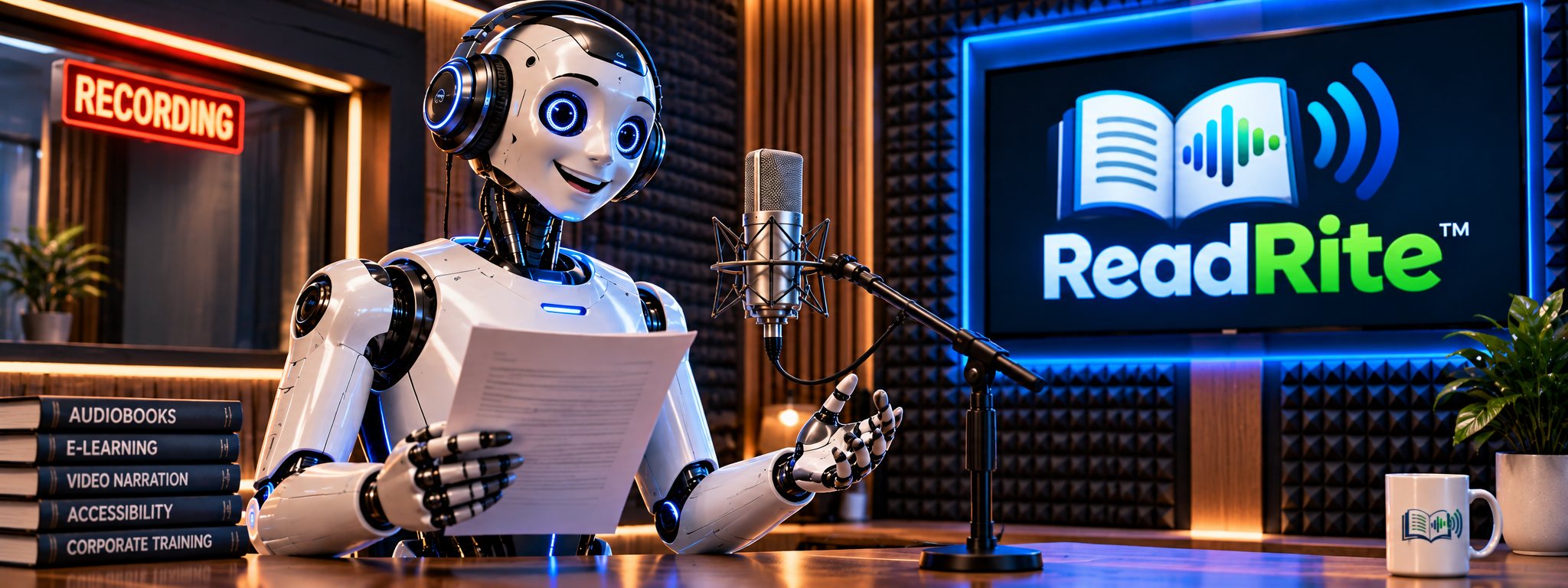
That’s the problem ReadRite™ is designed to address.
See How It Works
The Problem: Written English Isn’t Spoken English
Modern AI voices have become remarkably realistic. But realistic voices still have a fundamental problem:
They have to figure out how your written words should sound.
Consider:
Yesterday
I read the book yesterday.
Sounds like red
Tomorrow
I will read the book tomorrow.
Sounds like reed
The spelling hasn’t changed.
The pronunciation has.
A human reader understands the difference instantly. An automated narration system may need additional information to determine which pronunciation is intended.
And heteronyms aren’t the only challenge.
Names, unusual words, technical terminology, fictional characters, invented places, abbreviations, and specialized vocabulary can all create pronunciation problems.
One incorrect word can turn an otherwise convincing AI narration into an obvious machine-generated voice.
Definition
What Is a Heteronym?
The pronunciation of these words often depends on context.
A human reader naturally recognizes that context.
Text-to-speech systems don’t always get it right.
het·er·o·nym
1. A word that is spelled the same as another word but has a different pronunciation and meaning.
Examples:
- read — reed / red
- lead — leed / led
- wind — wind / wīnd
- record — REK-erd / rih-KORD
2. A small word with the potential to create a very noticeable problem for automated narration.
The Solution
The ReadRite™ Solution
ReadRite™ is designed to be the pronunciation intelligence between your written words and your AI voice.
Rather than simply replacing words with predetermined pronunciations, ReadRite analyzes words in context.
The goal is simple:
Help the voice say what the author meant.
ReadRite can identify words whose pronunciation may depend on their grammatical or contextual use and prepare the text for narration.
It can also provide a review process for questionable cases, allowing the author or producer to make the final decision.
Why ReadRite
Why Do You Need ReadRite?
AI narration can save enormous amounts of time and money.
But correcting pronunciation errors after an entire book, course, or production has been narrated can be expensive and frustrating.
ReadRite is designed to move pronunciation checking toward the beginning of the workflow.
Find potential problems before they become audio problems.
You may have to:
- Find the mistake.
- Determine why the voice got it wrong.
- Modify the script.
- Regenerate the audio.
- Locate the replacement passage.
- Edit the new audio into the original production.
- Repeat the process when another pronunciation problem appears.
Workflow
Save Time Before You Generate the Voice
Think of ReadRite as a proofreading step for pronunciation.
Without ReadRite
- Manuscript
- TTS
- Listen
- Find mistakes
- Fix
- Regenerate
- Edit
With ReadRite
- Manuscript
- ReadRite
- Review
- TTS
- Narration
The more text you produce, the more valuable that difference can become.
For a short video, one pronunciation error may take minutes to correct.
For an audiobook containing tens of thousands of words, repeatedly finding and correcting errors can consume hours.
ReadRite is designed to help catch those problems before the recording stage.
Who It’s For
Who Can Use ReadRite™?
Authors & Publishers
Prepare manuscripts for AI-assisted audiobook production and identify potential pronunciation problems before generating hours of narration.
Audiobook Producers
Reduce the need to repeatedly regenerate passages because of contextual pronunciation errors.
E-Learning
Improve automated narration for training courses, educational material, tutorials, and instructional content.
Corporate Training
Prepare presentations, training programs, procedures, and internal educational material for automated voice narration.
Video Production
Help prepare scripts for AI-generated voiceovers used in promotional, instructional, documentary, and social-media videos.
Accessibility
Support clearer automated speech for applications that convert written information into spoken content.
Podcasts & Audio Content
Prepare scripts for automated narration and other AI-assisted audio production workflows.
Beyond Heteronyms
More Than Heteronyms
Heteronyms are an important starting point—but pronunciation problems go beyond them.
A mature ReadRite system can be designed to handle:
Contextual pronunciation
Words whose pronunciation changes according to meaning or grammatical use.
Proper names
People, places, organizations, and other names that may not follow normal pronunciation rules.
Technical terminology
Scientific, medical, engineering, aviation, computer, and other specialized vocabulary.
Fictional terminology
Character names, planets, locations, organizations, and invented words.
Author pronunciation preferences
A customized dictionary can tell ReadRite how a particular word or name should be pronounced throughout a project.
Human Review
Put the Author Back in Control
AI narration doesn’t have to mean surrendering control over pronunciation.
ReadRite can identify situations that deserve attention and allow the author or producer to review them.
That means the system doesn’t have to pretend it knows the answer every time.
That combination of automation + human review is particularly valuable for books and other long-form projects where consistency matters.
Instead, it can say:
Potential pronunciation issue detected.
“I read the book yesterday.”
reedred
Then you decide.
How It Fits
Designed to Work With AI Voice Technology
ReadRite is not intended to replace your favorite voice technology.
Instead, it can serve as a preprocessing layer between your manuscript and the narration system.
That approach allows ReadRite to potentially work with different text-to-speech technologies rather than locking users into a single voice provider.
- Your Manuscript
- ReadRite™
- Pronunciation Review
- TTS / AI Voice
- Final Audio
The Benefit
The Benefit Is Simple
You already spent the time writing the words.
Your AI voice can turn those words into speech.
ReadRite helps make sure the speech doesn’t undermine the writing.
- Less manual checking.
- Fewer pronunciation surprises.
- More consistent narration.
- A faster production workflow.
- More control over your final voice.
Don’t Let One Word
Give Away the AI
The most convincing AI narration can sound remarkably human.
Until it doesn’t.
One strangely pronounced word can suddenly remind your listener:
“That’s an AI voice.”
ReadRite™ is made to help prevent that moment.
ReadRite™
Because what you write should be read right.